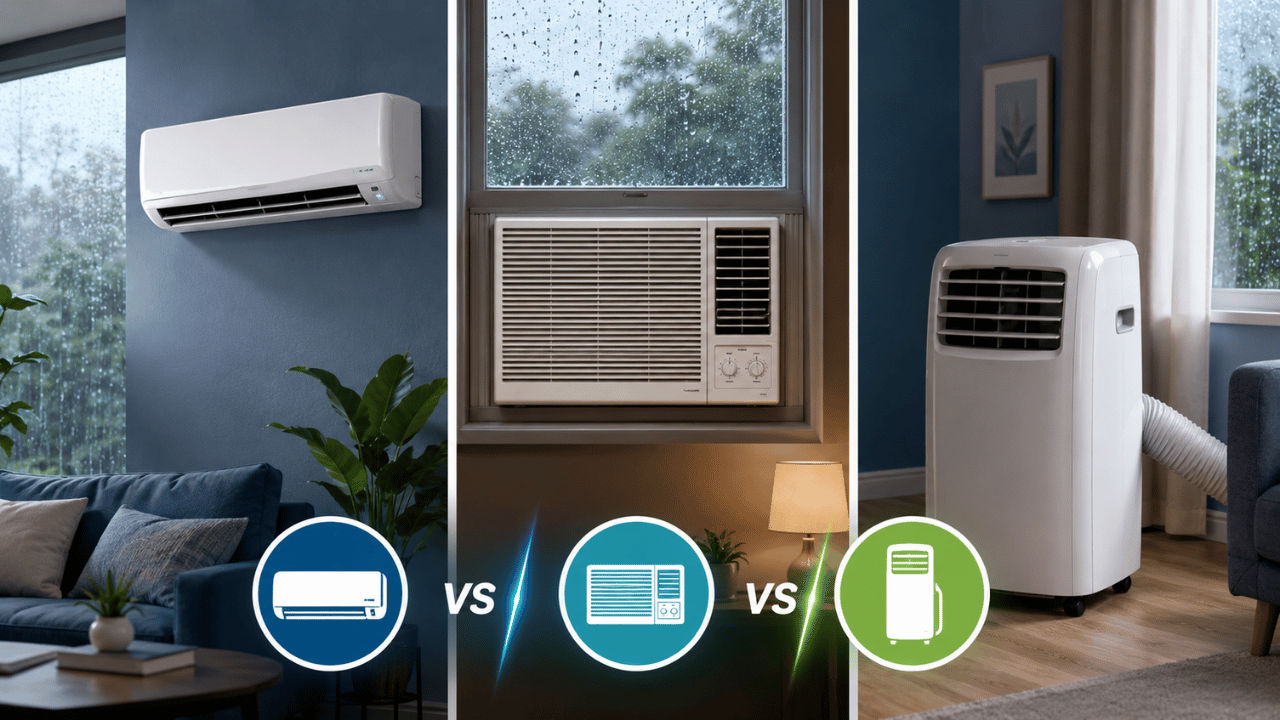
Split vs portable vs window AC: Which one is worth your money in monsoon?
Essential brief
Choosing the right air conditioner for the monsoon season involves understanding the differences between split, portable, and window AC units. Each type varies in cooling efficiency, noise levels,
Key topics
Key facts
Highlights
Why it matters
Selecting the appropriate air conditioner type for monsoon conditions impacts energy consumption, comfort, and long-term costs. Understanding the differences between split, portable, and window ACs helps consumers optimize cooling efficiency and manage electricity expenses during humid weather. This knowledge supports more sustainable and cost-effective cooling choices.
The monsoon season presents unique challenges for air conditioning due to increased humidity and sticky air, which can make rooms feel warm despite lower temperatures. Many consumers consider purchasing a new AC during this time but often face confusion between split, portable, and window air conditioners. Each type offers distinct advantages and drawbacks in terms of cooling performance, power consumption, noise, and installation requirements.
Split air conditioners generally provide the most efficient and rapid cooling because their compressors are located outside the room. This design also results in quieter operation, making split ACs suitable for bedrooms and quiet spaces. Window ACs offer decent cooling but tend to be noisier since the compressor and cooling unit are combined in a single unit installed in a window or wall.
Portable ACs have the lowest cooling capacity among the three, equipped with smaller compressors that limit their effectiveness to small spaces. They also tend to be the noisiest and least efficient, especially in humid monsoon conditions.
Regarding electricity consumption, a 1.5-ton 5-star rated split AC running for eight hours daily typically costs between Rs 1,800 and Rs 2,500 per month. Window ACs consume slightly more power, with monthly costs ranging from Rs 2,200 to Rs 3,000 under similar usage. Portable ACs are the most expensive to operate, with monthly electricity bills often between Rs 2,800 and Rs 3,800 due to higher power requirements to achieve comparable cooling.
Installation and maintenance costs also vary. Split ACs require professional installation costing between Rs 1,500 and Rs 3,000, and servicing is more complex due to separate indoor and outdoor units. Window ACs are simpler to install, usually costing less than Rs 1,000, involving drilling a hole in the wall. Portable ACs require no installation and can be easily moved between rooms, offering convenience but at the expense of higher operational costs.
Consumers should weigh these factors—cooling efficiency, noise, electricity consumption, and installation complexity—when selecting an air conditioner for monsoon use to ensure the best balance of comfort and cost-effectiveness.
Key topics in this update include split, portable, and window.