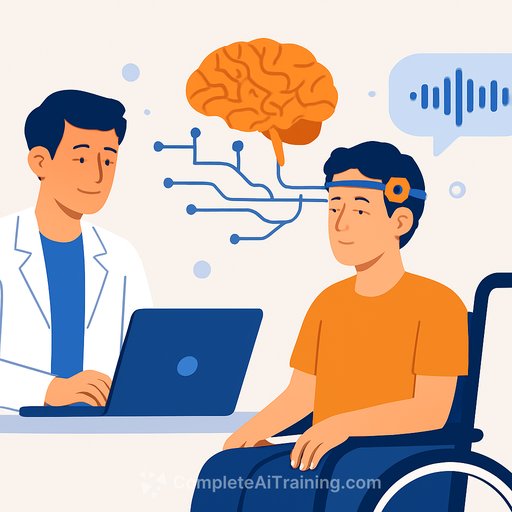
UC Davis researcher develops AI brain interface to restore speech for paralyzed patient
Essential brief
Researchers at UC Davis have created a brain-computer interface that enables an ALS patient to communicate with over 99% word accuracy using brain signals alone. Over two years, the system generate
Key topics
Key facts
Highlights
Why it matters
This innovation demonstrates the potential of AI-powered brain-computer interfaces to restore communication abilities in patients with severe paralysis, such as those with ALS. It highlights how integrating neural decoding with artificial intelligence can significantly improve quality of life and independence for individuals who cannot speak. The technology also paves the way for future developments in assistive communication devices across various neurological disorders.
A research team at the University of California, Davis, has developed an advanced brain-computer interface (BCI) that allows a patient with amyotrophic lateral sclerosis (ALS) to communicate through thought alone. The system interprets neural signals to generate speech with remarkable accuracy, achieving over 99% word recognition. This breakthrough represents a significant step forward in assistive technology for individuals who have lost the ability to speak due to paralysis.
The interface was tested over a two-year period, during which it produced approximately 2.7 million words. This extensive dataset highlights the system's reliability and potential for continuous use in real-world communication scenarios. The technology translates brain activity directly into text, bypassing traditional speech mechanisms that are impaired in ALS patients.
This development builds on previous efforts in brain-computer interfaces but distinguishes itself through its high accuracy and sustained performance over an extended period. The system's ability to maintain consistent communication output suggests it could be adapted for broader clinical applications.
The research underscores the growing role of artificial intelligence in interpreting complex neural data to restore lost functions. By enabling patients to express themselves more naturally and efficiently, this technology could improve quality of life and independence for those affected by severe motor impairments.
Future work will likely focus on refining the interface for faster communication speeds and expanding its accessibility to a wider range of neurological conditions. The UC Davis team's achievement marks a promising advancement in the intersection of neuroscience and AI-driven assistive devices.
Key topics in this update include davis researcher develops ai brain interface, davis researcher develops, and brain interface.